

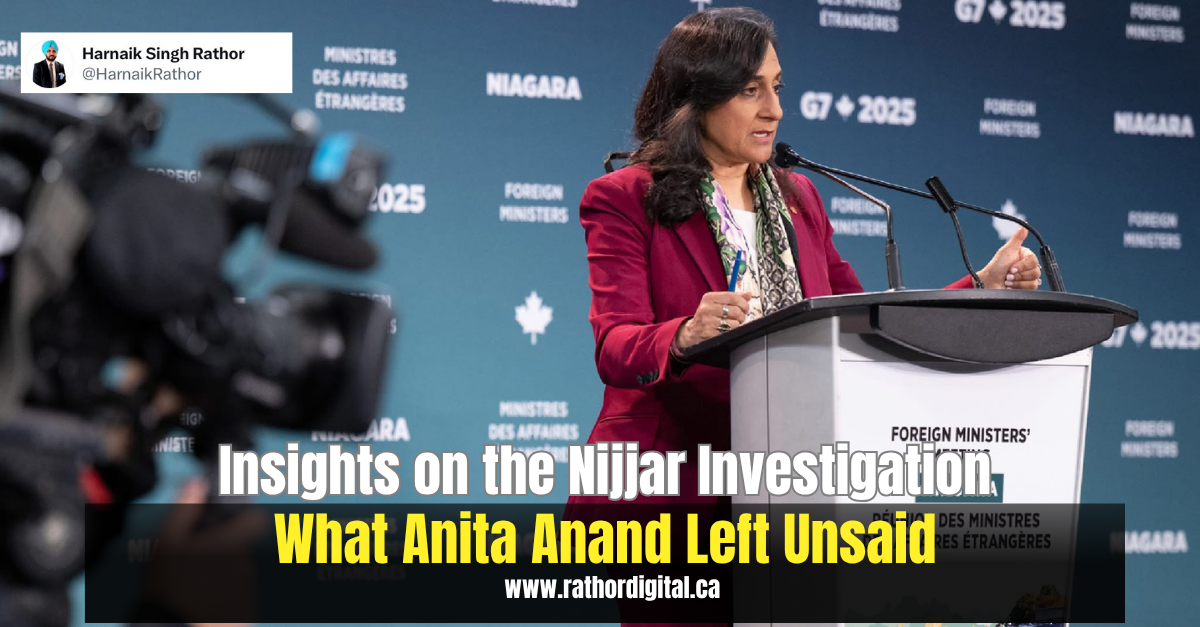

What Didn’t Anita Anand Say About the Nijjar Investigation?
Canada’s Foreign Minister Anita Anand on the Hardip Singh Nijjar Investigation: A Commitment to Rule of Law and Bilateral Cooperation
In a recent press conference held in Niagara, Canadian Foreign Minister Anita Anand addressed key questions regarding the ongoing investigation into the assassination of Hardip Singh Nijjar, a Sikh leader killed in British Columbia in 2023. The high-profile case has strained diplomatic ties between Canada and India, with serious allegations involving Indian government agents.
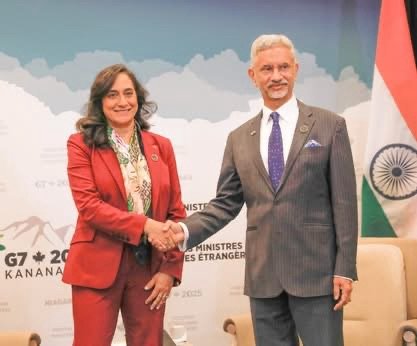
Minister Anand emphasized that Canada is committed to upholding the rule of law. She stated that government officials, including ministers and members of the legislative branch, do not interfere in judicial investigations or processes. This is a foundational principle in Canada’s justice system, ensuring fairness and impartiality.
Watch the clip of Press conference here :-
Regarding collaboration with India, Anand confirmed that there is a high-level law enforcement dialogue underway. This involves communication between Canada’s NSIA and Indian government law enforcement officials. The dialogue is ongoing and central to ensuring transparency and cooperation between the two nations on matters of mutual concern.
Anand also highlighted public safety as a priority for Canada. She noted that the Canadian government has designated the Bishnoi group as a terrorist entity under the criminal code, underscoring serious security concerns related to violence and extremist activities. This designation plays a critical role in Canada’s domestic security approach and forms part of the bilateral engagement framework with India.
The joint statement signed by Canada and India just weeks before reaffirmed the importance of law enforcement cooperation, respect for the rule of law, and maintaining public safety at the forefront of bilateral dialogue. Anand’s remarks stressed that these principles guide the ongoing diplomatic and security relationship, avoiding politicization or blame.
The conference also touched on a broader set of global challenges including discussions on Ukraine, global peace, and Canada’s Arctic diplomacy, reinforcing the country’s role in multilateral partnerships and international security.
The outcomes of the G7 Foreign Ministers Meeting in Niagara will shape international relations and global cooperation in the months ahead. As these leaders work together on pressing issues like peace and economic resilience, the world watches closely.
What do you think are the most important steps the G7 should take? Share your thoughts in the comments below.”
What are your thoughts on the key global issues discussed at the G7 Foreign Ministers Meeting in Niagara, such as Ukraine, Middle East peace, and economic resilience?”
“How do you see the role of international cooperation evolving in addressing these challenges?”
“What outcomes would you hope to see from multilateral meetings like the G7 gathering?”